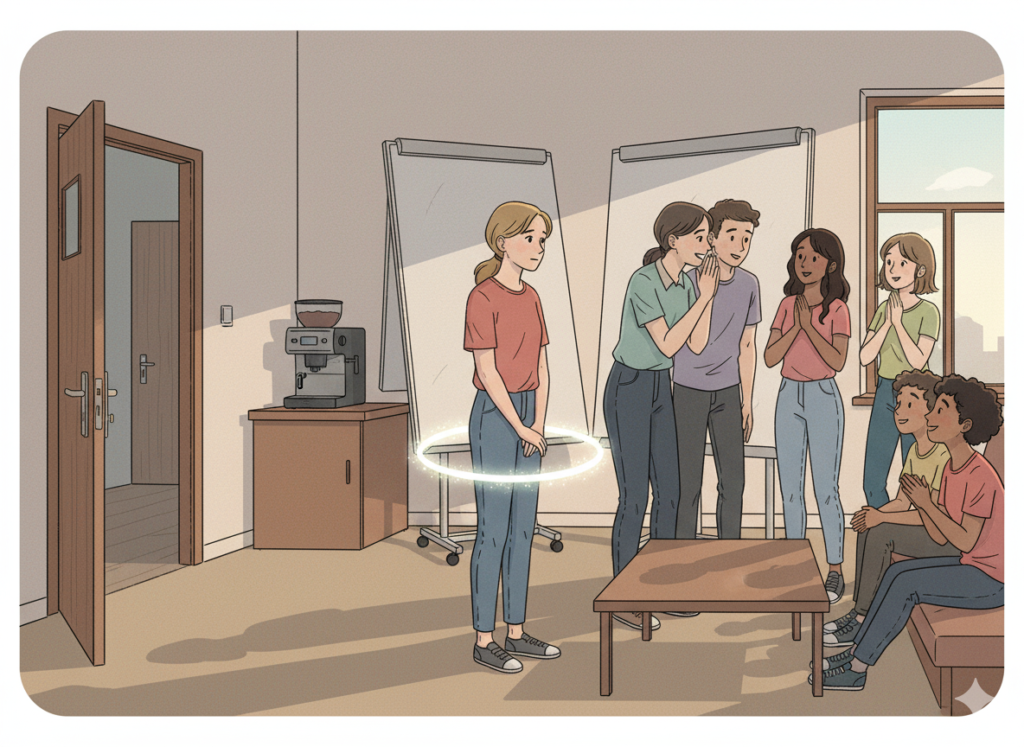
It was late summer and the hostel smelled of wet pine and freshly uncovered marker pen. Two youth groups were sharing the dining room, the laughter, and even the electrical outlets as if they were precious. The papers hung on the walls were curled as if they were getting tired, and the coffee pot marked changes in activity with an insistent beep. The large room still echoed with applause from the last workshop, and every time the door closed, it seemed as if the building could take a deep breath and be quiet for a while.
The new project had just started. A trainer arrived excited, but from the beginning he was pushed aside: the organizer and the person coordinating the team did not invite him to the meetings, they cut off his ideas in the middle of the talks and, although they told him “everything was fine”, they never told him what was really going on. No one listened to him or asked his opinion. Others noticed the silence and strange comments all around. At the end of the project, that person sent messages in case there was anything left to clarify… but no one responded. He knew that he had been left out, and that he was now on some kind of blacklist, completely isolated from the group.
– “Why doesn’t anyone tell me about the meetings?”
– “We didn’t think it was necessary.”
– “Why do you leave me alone to make decisions?”
– “Maybe you should be more flexible”
What would you do as a participant if you were in the group?
Possible performance:
Now (24 h):
– Ask for a real feedback space at the end of the day (anonymous paper/QR) for all participants, with two mirror questions: what helped me / what made me uncomfortable.
– Suggest a mini-team rules meeting with the two trainers and the organizer: turns of speech, transparent decisions and a “stop, here we take care” to cut ironies or punishing silences.
Bridge (72 h):
– Request a brief mediation with a neutral person from the host team (or parallel organization) to name tensions without personal finger-pointing and agree on how feedback will be received (who reads, when responds).
– Propose a mural of visible agreements: communication channels, how to ask for methodological changes and guarantee that no one will be penalized for giving their opinion.
Structural (next project):
– Clear code of conduct (no gatekeeping), rotation of roles in the training team and agreed co-facilitation (who decides what and how to review).
– 360º evaluation (participants ↔ trainers ↔ organization) with public feedback of learning and improvement commitments.
– Confidential channel to alert of ostracism or retaliation, and commitment to non-exclusion without verification process.
In the next 24 h I would… ask for that anonymous feedback space, talk to another allied participant person to go two by two to ask for mediation, and leave written record (dates, facts, not rumors).
Key structural change: every invitation to trainers should include co-working agreements and a protocol against subtle bullying (silences, exclusions, rumors), with consequences and external review.