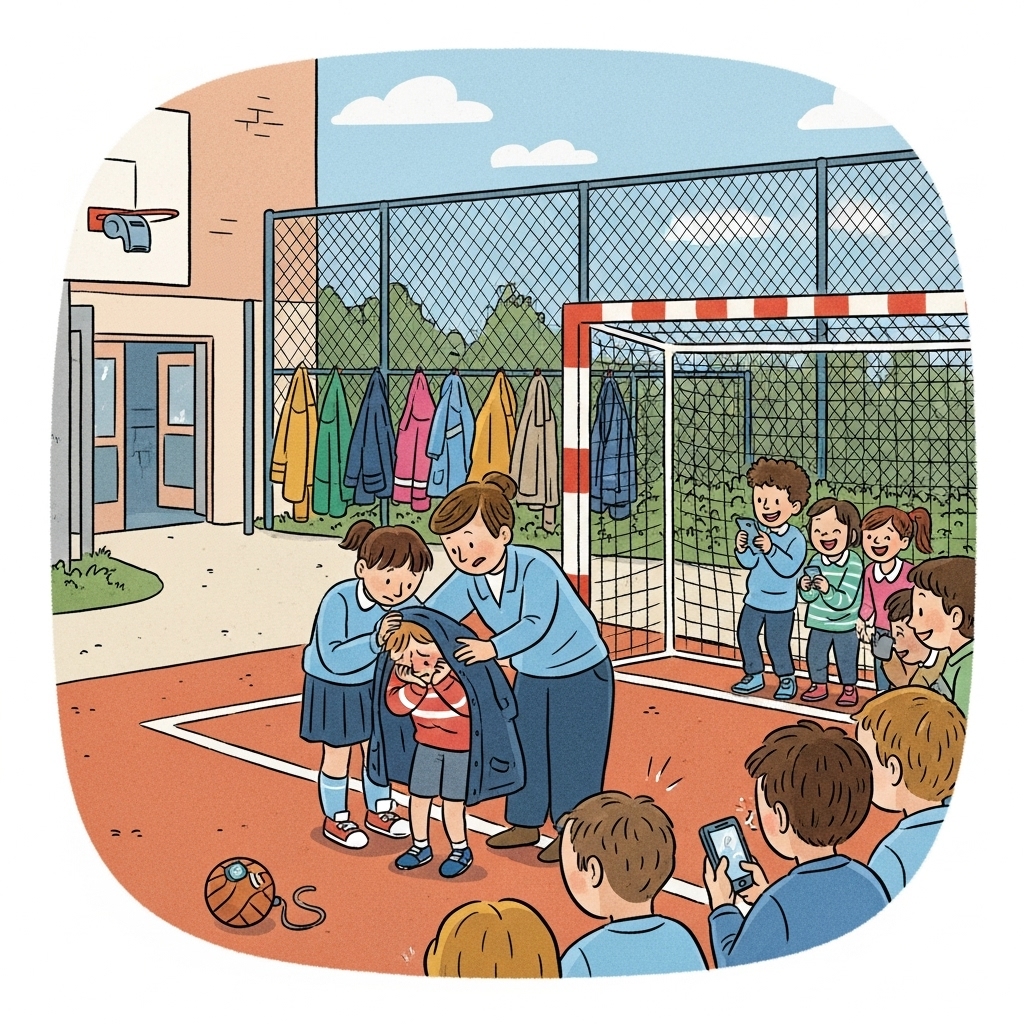
It was CM2 recess, and the playground smelled of hot rubber and spilled juice on the ground. The sun was bouncing hard off the goal. There was a line of coats on the fence, the whistle was blowing in the distance and laughter was running even faster than the balls.
It all happened in a second: a boy, nervous or perhaps challenged by others, pulled down his pants and underwear. Some froze and others started to laugh. The teasing started immediately: “soft ass”, “booger-eater”… But recess ended and the echo continued through the corridors, the dining room and even the exit. The boy walked with a cringe, feeling that every laugh reminded him of the moment. No one really asked what happened: was it a practical joke, a dare, were his clothes wet, was it curiosity, something sensory? All that remained was a label and an embarrassment that lasted all day.
– “Hey, look at him, how squishy!”
– “Stop. The body is not a joke.”
– “It was one second… and now I don’t know where to put myself.”
As a teacher, monitor or partner, how do you protect their dignity now and cut the cycle?
Immediate (10 min): cover and take to a private space; prohibit recording/sharing, check for videos and ask for deletion with adult; name the rule: “the body is not commented on”.
2. Supportive (24-72 h): talk to him (no blame), investigate cause, inform family, safety plan (support partner), make amends with brief circle if desired (name harm, apologies, agreements).
Structural (30 days): “my body is not an issue” posters, anti-bullying protocol, active witness training and blind spot monitoring.
Roles at the table: child protagonist, aggressor leader, laughter chorus, partner ally, playground monitor, teacher, counselor.