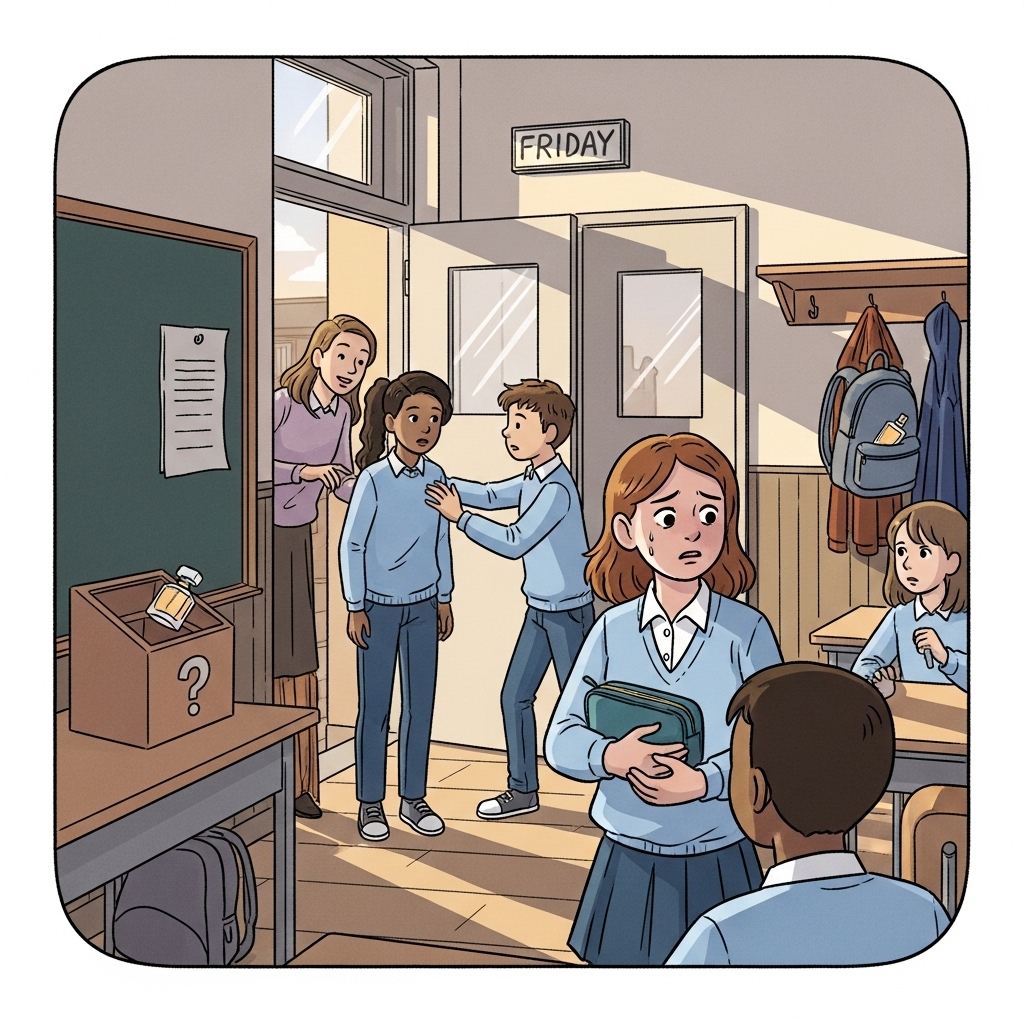
Friday afternoon class. The building is breathing slowly and the sun is bending through the glass. In the second module, Alexandra lends a pen; behind, a classmate asks her about her perfume. “It smells good,” she says, and the classroom goes on as if nothing has happened… for now.
At recess, the same classmate explodes: she accuses Alexandra of stealing a perfume she lost the day before. Loud voices are heard, “liar”, and laughter from the group. On re-entering the center, she is assaulted with a hair pull: “confess”. A classmate stands between the two and stops the aggression. In class, Alexandra bursts into tears and the teacher notifies the head teacher. Without evidence, she was declared innocent. On Monday, the perfume appeared in the backpack of another student who had forgotten it at school. No one apologizes. Then there is an anti-bullying talk, but the bitter taste persists.
– “You smell just like mine – you stole it!”
– “I can prove what I wear.”
– “Liar!”
– “Stop. No proof, no accusations.”
I am your partner and I act.
1. Now (10 s): I stand next to you: “You stop. If something is missing, we go to the teacher and make a timeline”.
2. Safety: separate bodies, offer water and escort to tutoring/CPE; ask for temporary non-contact.
3. Facts, not shouting: I suggest checking classroom, hallways and lost objects before pointing at anyone.
Log: note time/place/witnesses; submit report with another ally.
5. Reparation: if proven innocent, I ask for a brief public apology and a restorative circle (without humiliation) for closure.
6. Class: visible agreement: “No accusations without proof. Zero aggression. Procedure for lost objects”.
Roles at table: Alexandra, accusing classmate, intervening classmate (narrator), teacher, head teacher/management, student in whose backpack the perfume appeared, class group.