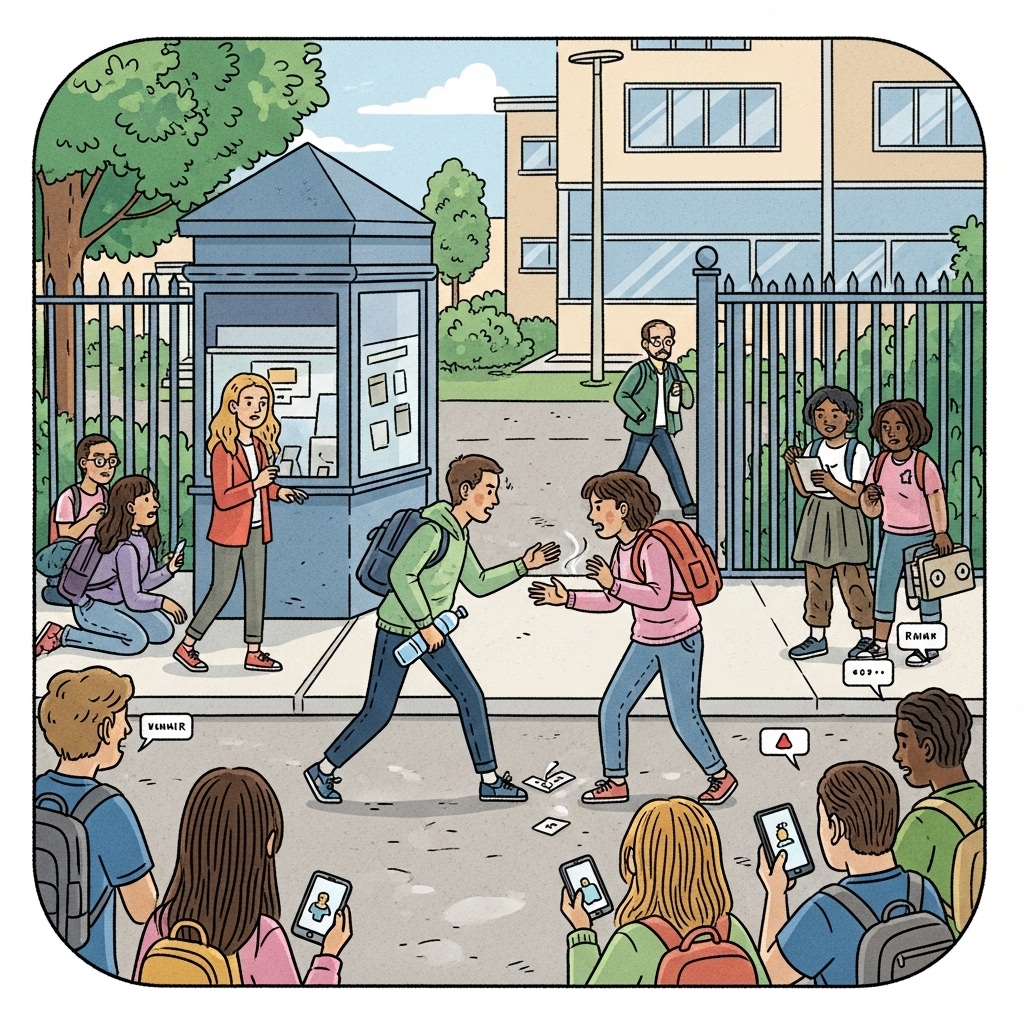
Outside the high school, the gate vibrates like a giant drum. Cell phones tell the time and the rumor spreads by word of mouth: “five o’clock”. A semicircle of backpacks forms in the corner of the kiosk, and the air smells of hot asphalt and fighting nerves.
It all started with an insult to my friend’s mother. She couldn’t take it: “See you outside,” she said. They arranged to confront each other and, when the time came, the pushing and shoving began. I took two steps to the center, opened my hands and asked for air between everyone. I tried to separate with my voice and then with my body. I named what was happening, without pointing at anyone: I asked everyone to say what hurt and what they needed to stop. In between short breaths, someone was encouraged to say “sorry” and they shook hands. As the whole group looked on, I proposed, “No audience, we continue in tutoring.” We left with less noise than we had made when we arrived.
– “Don’t ever talk about my mother again.”
– “At five o’clock, if you dare.”
– “Stop! This stops here. Say what hurt you and what you will do differently.”
I’m another classmate and I see it coming from recess.
1. Before (prevention): cut the “at five” in the group: “We don’t make appointments to fight. If there’s a problem, let’s go to tutoring”.
2. Minutes before: I approach both of them separately, propose a pause and a guided meeting with an adult; I look for two allies to avoid an audience.
3. If it has already started: I create distance with a firm voice (“space”), call an adult, offer water and words (“this hurts, let’s stop”).
4. Afterwards: I accompany to ask for concrete apologies, we agree on limits (“families do not touch”), and we set a review in 48 hours.
Roles at the table: insulted friend, insulting child, student mediator, peer witness (narrator), teacher on duty/CPE, chorus of spectators, friend ally.