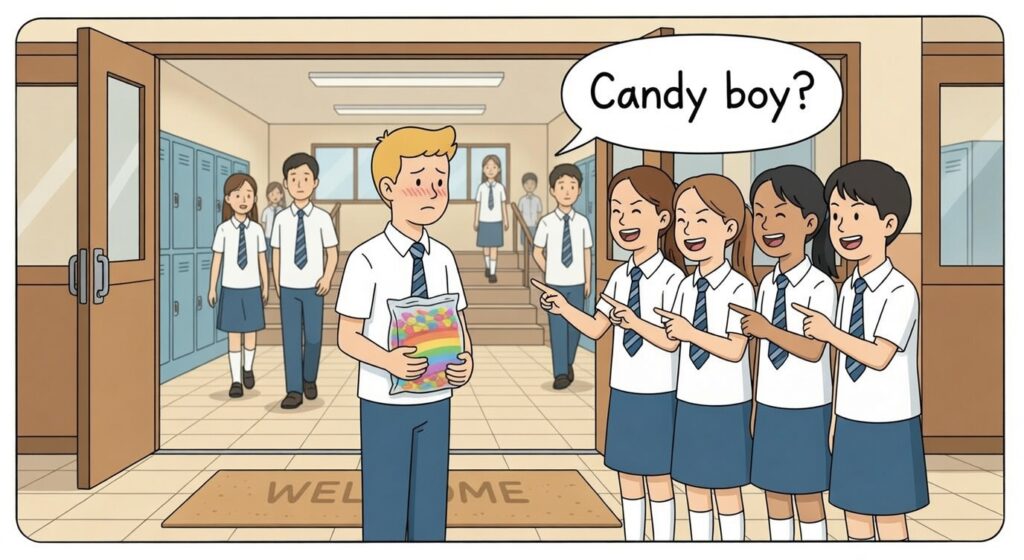
It was a gray morning outside the high school. The kiosk smelled of licorice and cold coins. When the gate closed, the whole ground vibrated. A group of high school students occupied the sidewalk as if it were their own; next to them, a little elementary school boy clutched his bag of candy.
I see how they surround the boy. One makes jokes, another stretches out his hand and, amidst laughter, the bag of sweets passes into the hands of the older one. The little one is left with empty fingers, looking at the floor. I look around: the teachers are far away, the classmates look away, no one intervenes. I don’t do anything either. I just want to go unnoticed and feel part of the group. But this happens a lot, all through the course. Every time I see it I feel ashamed of myself, like the sticky sugar in jelly beans: sweet on the outside, but inside I feel that something is wrong.
– “Hey, share… or better, give them to me.”
– “It’s just a joke, man.”
– (whisper) “Give them back, it’s not yours.”
– “And who are you?”
As a witness, janitor or guardian, design a safe and effective response:
1. now (10 minutes): stand with the child, name the behavior (“you’re taking something that’s not yours”), enlist a nearby adult, offer immediate replacement, and collect data (who, where, when).
2. 72 h: formal debriefing, restorative conversation if child desires (return/pay, apology, agreements) and follow-up at intake.
3. Structural (30 days): “safe zone” in access, visible adult shifts, senior mentors, active witness campaign, and clear consequences for recidivism.