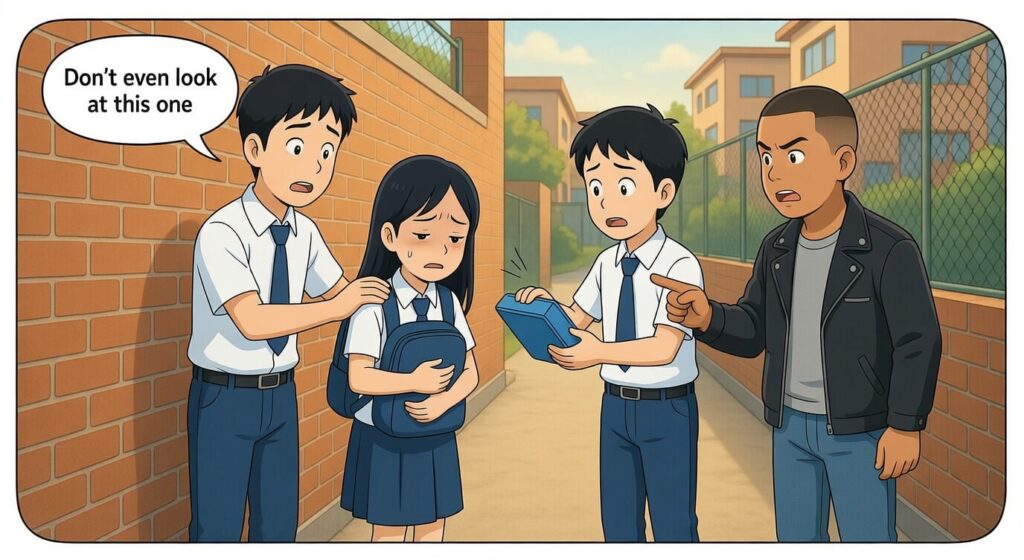
Noon at the neighborhood school. Lunch is the most valuable thing in the backpack. At home, a small and too quiet apartment: mom comes in and out of the hospital, and you, at 10 years old, learn to live practically alone. You live alone and are afraid to go to school.
When you come back from school you always have to pass through the same place, not doing so would mean walking 30 minutes more. Two older boys corner you, push you, threaten you every day and take away your food.
Your body hurts and so does your stomach, empty because of others. One day you seek “protection” outside: you make friends with the leader of a neighborhood gang. You buy him a console of dubious origin with your savings and tell him about your problem with the two boys. He accompanies you to where they are and tells them: “Don’t even look at this one”. From that day on they never bothered you again.
-Give us what you’ve got.
-It’s mine…”
– “Don’t even look at this one.”
– “What if they come back?”
– “They won’t come back.”
If I’m your partner and I decide to really take care of you, from school:
Now (10 s): I stand up with you at recess and say clearly, “Enough! No one pushes or steals food.” I accompany you to where the monitors are.
24 hours: We go together to the tutor or to orientation: we register who does it, where and when; we ask that the older children stay away, that they keep a closer eye on that area and that you have a safe route between classes.
Food and support: I find out if you can get into the school cafeteria or ask for scholarship assistance; this week I eat with you and propose that we have a support couplet for entrances and exits.
If there is danger: We don’t face it alone; we alert the custodian or CPE.
Structural (1 month): We suggest that the school has signposted “safe points”, guarded playgrounds, lockers near teachers and a sign with clear channels of help (including the social worker) for those who are home alone.
This way everyone understands:
The protection that counts is that of the school and those who care, not that of a favor bought outside.
No one should go hungry or be afraid.
Peer and adult support is what makes a difference and gives security.
If you see, don’t just watch: accompany, ask for help and propose safe paths for those who feel alone. In this way we really support and break the law of fear.
Roles at the table: child protagonist, aggressor 1 and 2 (older), allied partner (narrator), tutor, CPE/counselor/social worker, playground monitors.