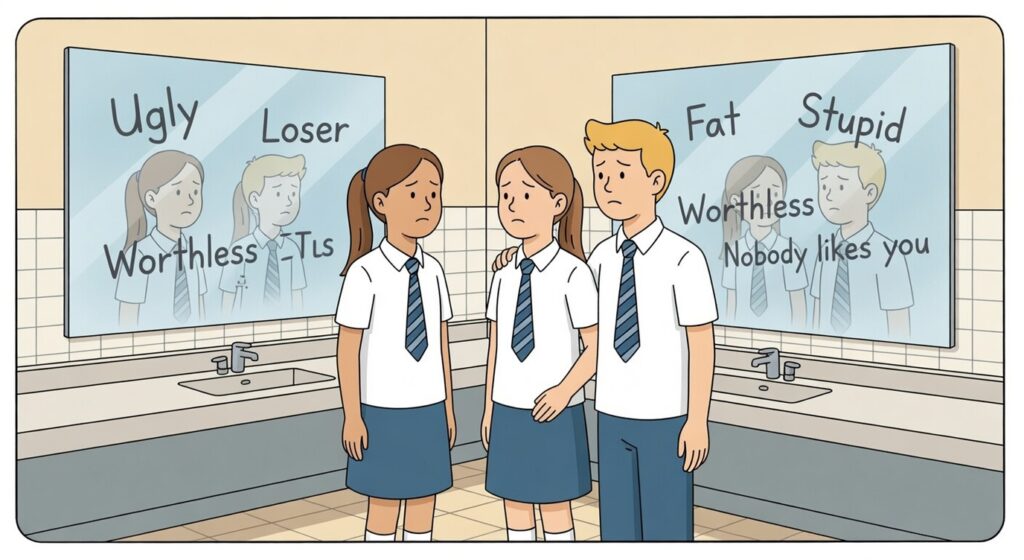
It was recess in elementary school. The playground smelled of hot rubber and tangerines. The sun made the swings sparkle, and in the bathroom window the glass gave you back your half-twisted reflection: sometimes you used it to fix your shirt, sometimes to doubt how you looked.
Two colleagues started to look at me funny because of my appearance. First it was giggles and “what a looker” faces, then comments about my hair, my clothes and my body every time they passed by. I tried to shrug it off, pretending I wasn’t listening, but inside I was shutting down. I wanted to tell someone, but I was held back by fear: What if it was worse? What if they told me I was exaggerating? I learned to cross the courtyard without seeing them, to arrive last in line so as not to run into them. The sadness didn’t go away even when the bell rang and I went back to class.
– “Look at you, you look like…”
– “Stop it, it’s not funny.”
– “If it bothers you, why don’t you say anything?”
– “Because I’m afraid it will be worse.”
As a peer, teacher or playground monitor, what would you do this week to cut the hurt and make the person feel safe to speak up?
1. Immediate (48 h): stop public teasing (“no body talk here”), offer discreet channel (card/QR/box), and assign “support partner” at recess.
2. Restorative: brief guided meeting if victim wishes: name impact, concrete apology, verifiable agreements (no comments on appearance).
Structural (30 days): “my body is not an issue” sign, active witness training, review of blind zones in the playground, and clear consequences for repeat offenses.
Roles at the table: student narrator, aggressor 1, aggressor 2, friend ally, teacher, playground monitor.