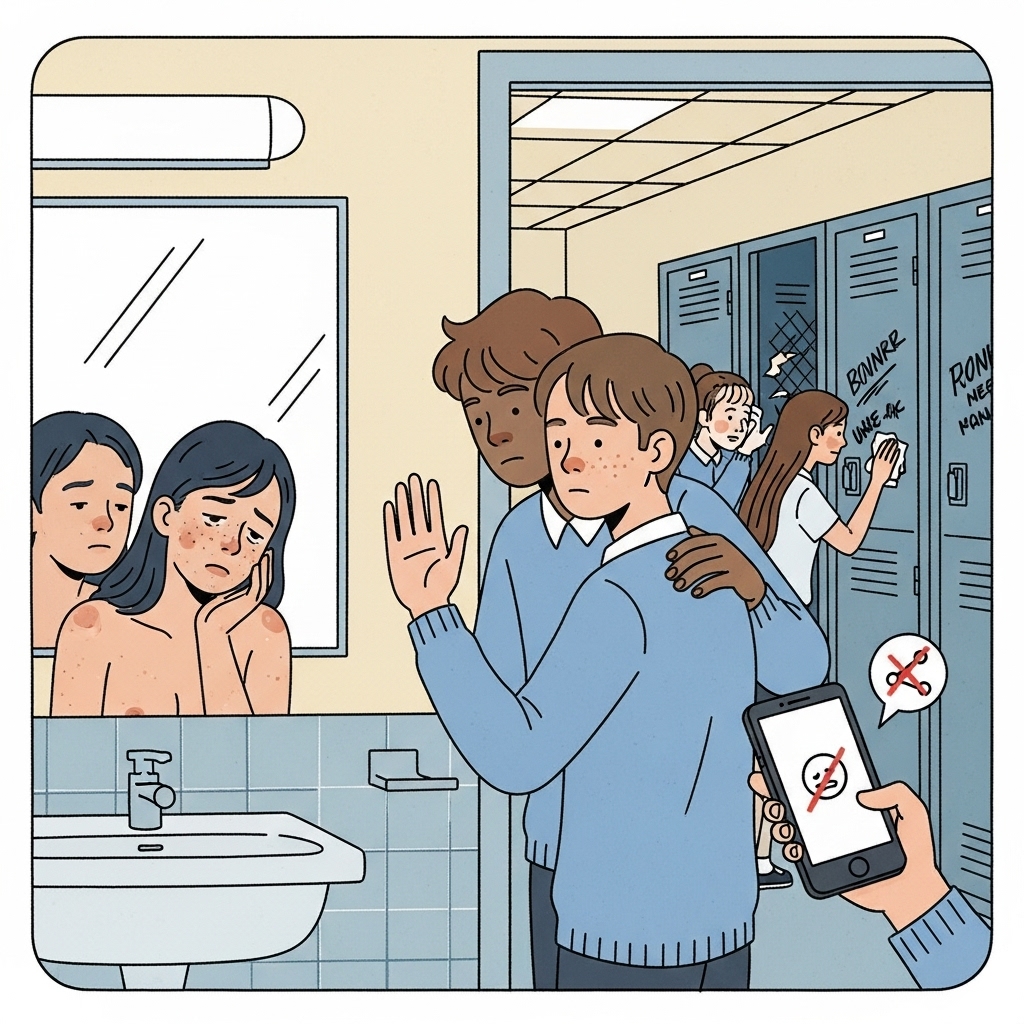
At the change of class, I looked at myself in the bathroom mirror under the white light. The hallway smelled of cologne and wet paper. On the lockers were joke phrases written in marker that someone always tried to erase, but they never quite came off.
You’d been hearing the same thing for more than six years: comments about your weight, your pimples, your body. Sometimes they were direct jokes; other times, just gestures, pictures or emojis that hurt just the same. You said many times that it was over, but inside it was engraved forever. You learned how to dodge groups and other people’s cameras. No one noticed how tiring it was to defend yourself every day from a mirror with an audience.
– “Relax, it’s humor.”
– “If it stays in my head for years, it’s not humor.”
– “It’s no big deal.”
– “For me it was, and it is.”
I’m your partner and I don’t want this to go on.
1. Now (10 s): I stand next to you and say clearly: “No body and skin comments here. We stop.
2. In the group: I write “don’t forward/delete” and ask two more to hold it.
3. Bridge: I propose you to be a support partner this week and I accompany you to tutoring to record dates and names if you want.
4. In class: I ask for 1 minute to agree on a visible rule: “My body is not a topic.
5. If there is recidivism: I collect evidence, raise it with two other witnesses and ask for measures (no contact, consequences).
6. This month: I organize with the teacher a talk on body image and a quiet space for those who need to breathe.
Roles at the table: affected student, peer ally (narrator), mock leader, chorus of laughter, tutor/CPE, delegate, passive witness who can be activated.