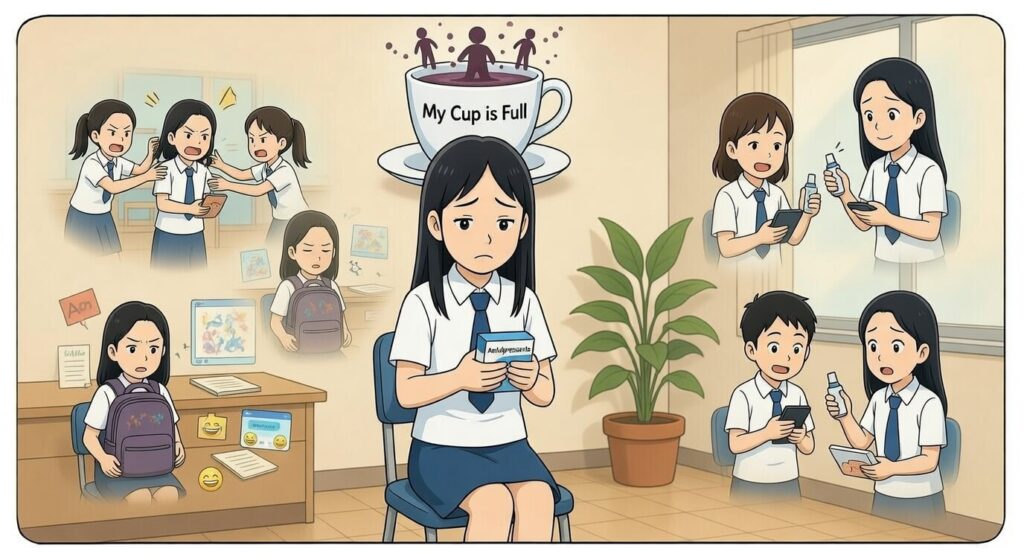
It’s sixth grade, in the damp autumn. The classroom smells of marker and wet jackets and, in the hallway, papers stuck to the corkboard rustle as if they hold secrets. Returning from recess, an open backpack waits on the desk.
It’s been years of bullying: at first just words and pushing and shoving, then screenshots and messages. In 8th grade, the line is crossed: obscene drawings on the backpack and vulgar notes on the desk. One day, when you return to class last, you’re offered mouth spray and later learn that someone slipped it in your underwear. In 9th grade the intensity drops, but you already have your “cup” full and you think about hurting yourself. You get to therapy, are diagnosed with depression and start medication. Today you tell your story so that no one else goes through that tunnel alone.
– “It’s just teasing.”
– “No, it’s bullying. And today it stops.”
– “I’m embarrassed to tell.”
– “The shame is not yours.”
I am your partner and I act.
1. Now (10 s): I stand next to you and take you out of the circle: “Space”.
2. Evidence (2-3 min): I keep untouched what they left behind (clean bag), photograph notes/drawings and screenshots.
3. Safe adult: we go together to tutoring/CPE/nursing; I ask for immediate no-contact and camera/area check.
4. Health and care: nursing in case there was a risk; I accompany you to orientation and offer to be a support partner this week.
5. Networking: cut the gossip in the group (“don’t forward, delete; report if it continues”) and recruit two allies.
6. If you say you want to hurt yourself: I don’t leave you alone, I notify an adult and we call the center’s emergency/resources.
7. Class: I propose visible rule: no sexualized humiliation; anonymous channel; follow up within 72 h.
Roles at table: affected student, leader aggressor, accomplice, peer witness (narrator), tutor, CPE/counseling, nurse, delegate.