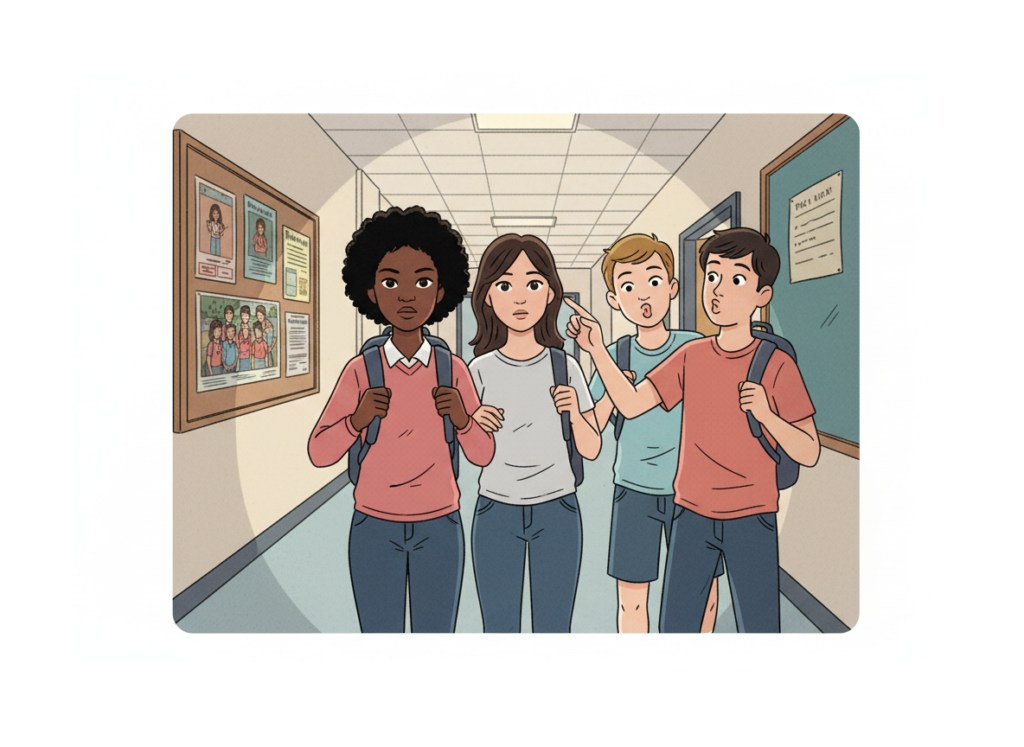
The first bell rings and the hallway smells of wet clothes. As you walk in, everyone looks at you funny and whispers your name wrong. It’s not a special day; it’s just another day being the only black girl in the school.
They separate you from the rest with awkward questions about your country, touch your hair without permission and laugh or whisper when you walk by. They never make an effort to say your name right. When they talk about racism in class, they always use you as an example, without asking you. In the lunchroom they leave the table just for you, and the teasing and stares make you feel more and more out of place, as if you are invisible. Every day feels like a struggle to be respected and seen as a person.
– “Can I touch your hair? It’s weird.”
– “I’m not a curiosity, I’m a person.”
– “That’s my name, it doesn’t cost you to say it right.”
As a peer, teacher or management, what would you do today and this month?
1. Today (24 h): say the name correctly; stop microaggressions (“don’t touch her hair”); sit next to her; offer accompaniment and safe channel.
2. Week 1: restorative circle if she wants it; classroom agreements (consent, teasing, boundaries).
3. Month 1: visible anti-racism plan (reports, follow-up), teacher training on bias, curriculum with real representation, affinity group and mentoring.
Roles at table: student storyteller, peer ally, teacher, peer doing microaggressions, head teacher, counselor.