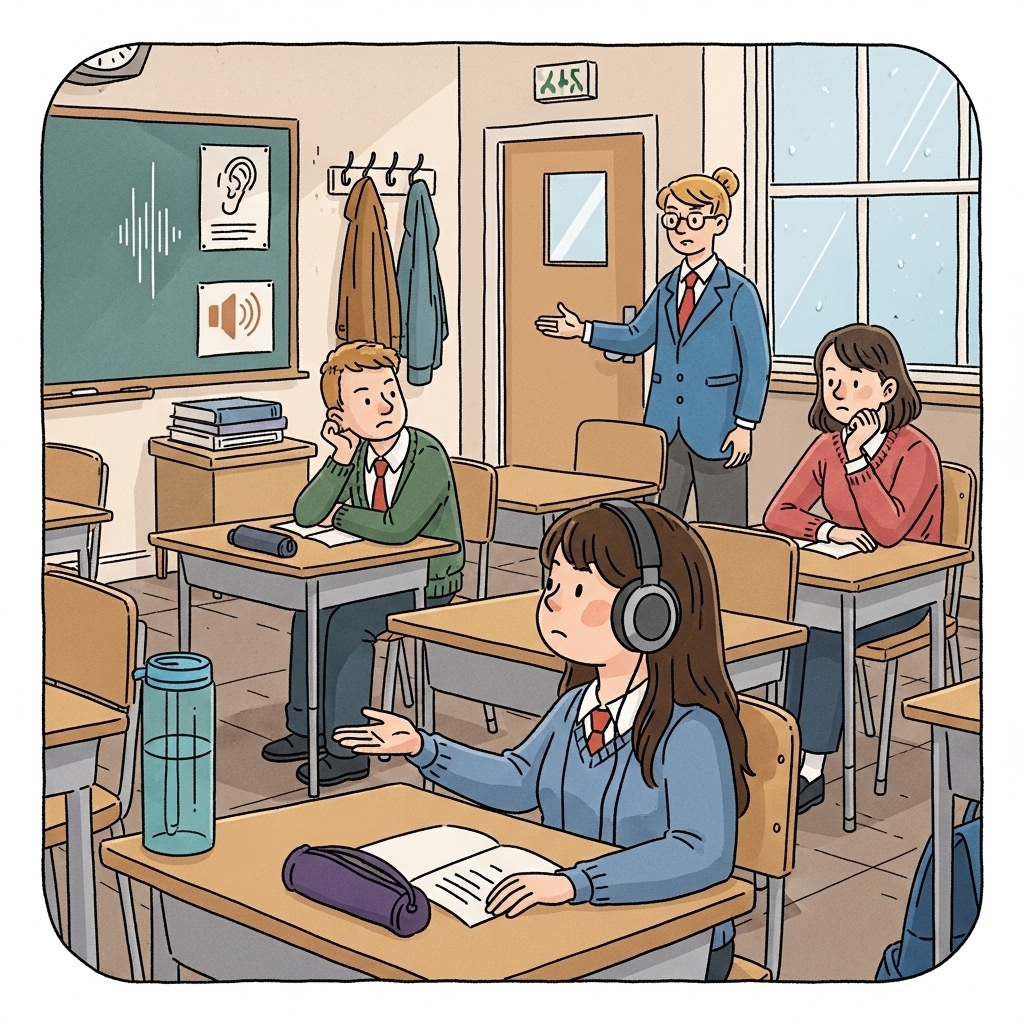
Senior year of high school. In English class it’s all noise: fluorescent lights sizzle, chairs shuffle, people talk loudly. He enters with his helmets, which are like his refuge when the noise bites his head. The air smells of marker pen and rain, because all the coats are wet.
Since he was a child, he was called “the weird one”. But before, he was included: he played with the others, went to get-togethers, nobody pushed him away. This year he started to get tired: he was teased because he was afraid of sounds, because he didn’t talk much, because he sometimes preferred to stay apart. One of them, who thought he was very cool, would poke him every day, and he didn’t fight back. In a short time, they stopped inviting him and his desire to go to school went away.
Everything exploded in English class:
– “Next to this stinker I don’t sit.”
There was an awkward silence.
The Guidance Department jumped in quickly: they talked to him, to his friends, to those who made him feel bad and to the one who always bothered him. No one got out of the brown without talking. With mediation, everyone had to listen, apologize and learn respect. The atmosphere changed. In the end, he breathes.
– “Next to this stinker I don’t sit.”
-(me) “Here we sit with respect. If something bothers you, we talk about it, no humiliation.”
-(teacher) “We move now and then deal with it with Guidance.”
If today I am your partner and I act:
Now (10 s): I sit next to him and say clearly, “Enough, we change places but no insults.”
Next minutes: I ask the teacher to change seats and respect his needs (that he can wear helmets, have a calm corner).
In the next 72 h: I accompany her to record what has happened. I help him to ask for non-contact with the one who insulted him and that there is a restorative circle: that everyone listens, asks for forgiveness, agrees how to treat each other.
Week 1: I propose that in the classroom we put rules clearly visible: “No ableism, no name-calling, we respect who needs helmets or pauses.” And that there is always a partner who is an ally so that we are not left alone.
Month 1: We create a map of the noisiest places and establish break times. The group receives a simple mini-course on autism (Asperger’s): what it means, how to care and understand the differences.
So everyone understands that neither noises, nor insults, nor nicknames make the group better. And that sitting next to someone and saying “respect” can really change the atmosphere.
Roles at the table: student with autism (Asperger’s), peer aggressor, peer ally (narrator), friends who made a vacuum, English teacher, Guidance Department, class group.