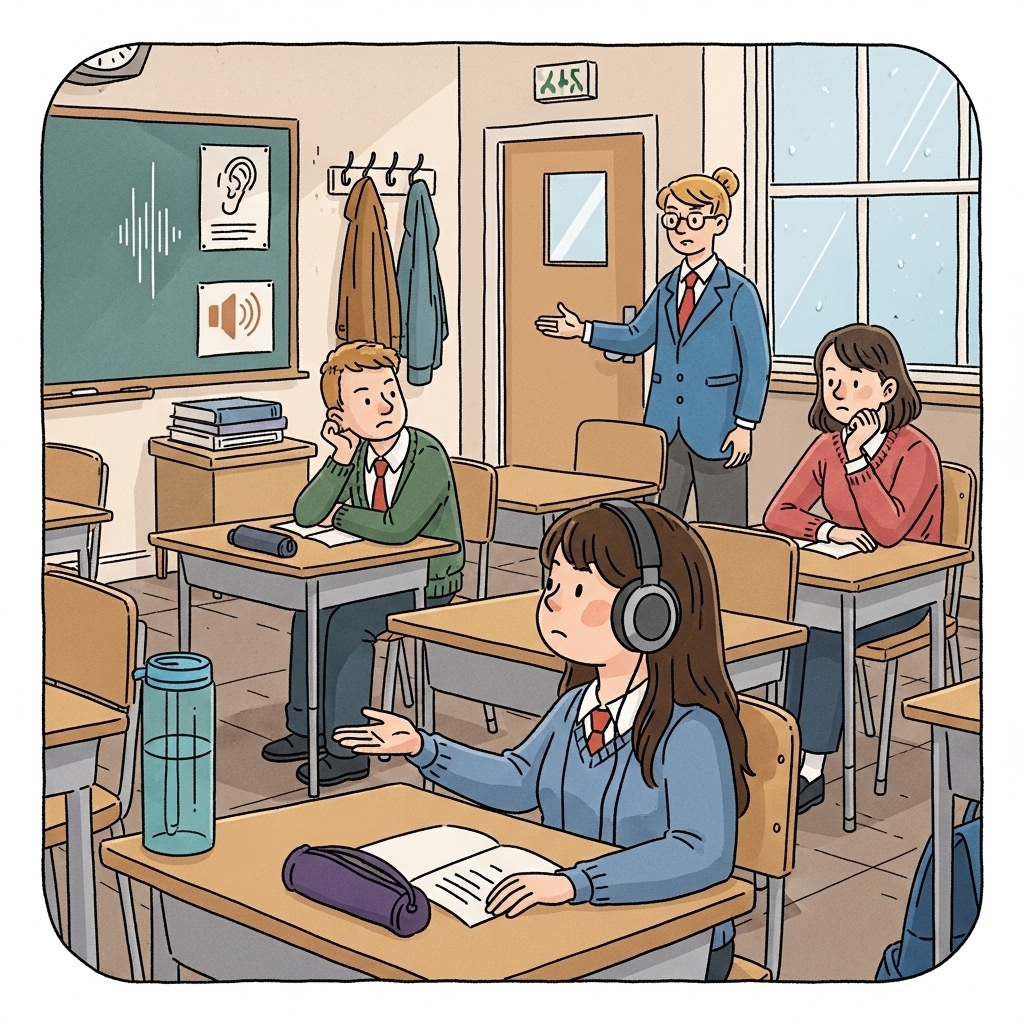
Último año de secundaria. En la clase de inglés todo es ruido: los fluorescentes chisporrotean, las sillas se arrastran, la gente habla fuerte. Él entra con sus cascos, que son como su refugio cuando el ruido le muerde la cabeza. El aire huele a rotulador y a lluvia, porque todos los abrigos están mojados.
Desde que era niño, lo llamaban “el raro”. Pero antes, lo incluían: jugaba con los demás, iba a quedadas, nadie lo apartaba. Este curso empezó a cansarse: le hacían bromas por su miedo a los sonidos, porque hablaba poco, porque a veces prefería estar aparte. Uno que se creía muy chulo lo pinchaba cada día, y él no se defendía. En poco tiempo, dejaron de invitarle y las ganas de ir al cole se le fueron.
Todo explota en clase de inglés:
—«Al lado de este apestoso no me siento.»
Se hizo un silencio incómodo.
El Departamento de Orientación saltó rápido: habló con él, con sus amigos, con quienes le hacían el vacío y con el que siempre lo molestaba. Nadie salió del marrón sin hablar. Con mediación, todos tuvieron que escuchar, pedir disculpas y aprender a respetar. El ambiente cambió. Al final, él respira.
—«Al lado de este apestoso no me siento.»
—(yo) «Aquí nos sentamos con respeto. Si te molesta algo, lo hablamos, no se humilla.»
—(profe) «Nos movemos ahora y después lo tratamos con Orientación.»
If today I am your partner and I act:
Now (10 s): I sit next to him and say clearly, “Enough, we change places but no insults.”
Next minutes: I ask the teacher to change seats and respect his needs (that he can wear helmets, have a calm corner).
In the next 72 h: I accompany her to record what has happened. I help him to ask for non-contact with the one who insulted him and that there is a restorative circle: that everyone listens, asks for forgiveness, agrees how to treat each other.
Week 1: I propose that in the classroom we put rules clearly visible: “No ableism, no name-calling, we respect who needs helmets or pauses.” And that there is always a partner who is an ally so that we are not left alone.
Month 1: We create a map of the noisiest places and establish break times. The group receives a simple mini-course on autism (Asperger’s): what it means, how to care and understand the differences.
So everyone understands that neither noises, nor insults, nor nicknames make the group better. And that sitting next to someone and saying “respect” can really change the atmosphere.
Roles at the table: student with autism (Asperger’s), peer aggressor, peer ally (narrator), friends who made a vacuum, English teacher, Guidance Department, class group.